7 Critical SEO Mistakes in Georgia
You've invested thousands of GEL (or dollars) into a professional website for your business in Georgia. The design looks great, the content seems solid, but there's one glaring problem: nobody can find you online.
No phone calls. No email inquiries. Just digital silence.
Meanwhile, your competitors—some with objectively worse websites—are dominating the first page of Google for crucial search terms like "web development Tbilisi", "hotel in Kutaisi", or "accounting services Batumi". You're left wondering: what are they doing that you're not?
Here's the truth that nobody in the digital marketing Georgia landscape wants to admit: most websites in the Georgian market are making the same fundamental SEO mistakes. These aren't minor technical issues—they're critical oversights that completely sabotage your online visibility and website optimization efforts in Georgia.
The good news? SEO isn't rocket science, and most of these problems can be fixed without a massive budget. After conducting a comprehensive SEO audit in Georgia covering over 150 websites across Tbilisi, Batumi, Kutaisi, Rustavi, and other Georgian cities, we've identified the 7 most damaging SEO errors that are costing businesses real revenue.
Let's dive into each mistake, why it matters specifically for online marketing in Tbilisi and beyond, and exactly how to fix it to boost your organic traffic in Georgia.
Critical Error #1: Neglecting Hyper-Local SEO for Georgian Cities
Why Georgian Businesses Lose Local Search Visibility
Your website exists in a geographic vacuum. There's no clear connection to Tbilisi, Batumi, Kutaisi, Rustavi, or any specific location in Georgia. This is particularly damaging because over 60% of searches in Georgia have local intent—people are looking for services "near me" or in their specific city.
We recently audited a Tbilisi-based law firm that ranked on page 4 for "lawyer Tbilisi" despite having 15 years of experience. Why? Their website optimization for Georgia was non-existent; they never explicitly mentioned Tbilisi anywhere except the footer address. Google simply didn't understand they were a local business, which is a common failure in online marketing in Tbilisi.
Real Example from the Georgian Market:
A restaurant in Batumi was getting zero organic traffic despite excellent reviews. They had beautiful food photography and a well-designed site, but no location optimization. After implementing local SEO optimization strategies, they started appearing in the "restaurants near me" pack and saw a 340% increase in website visits within 3 months.
Impact on Your Digital Marketing Results in Tbilisi
- You're invisible for high-intent searches like "SEO services Tbilisi", "dental clinic Kutaisi", or "graphic designer Batumi"
- Google Business Profile (formerly Google My Business) isn't connected to your website, hurting your web presence in Georgia
- International competitors without physical presence in Georgia outrank you
- You miss the "Local Pack" (map results), which gets 44% of clicks for local searches
Local SEO Optimization Strategy for Georgian Markets
1. Claim and Optimize Your Google Business Profile
This is absolutely critical and completely free. Here's what to do:
- Go to google.com/business and claim your listing
- Choose the correct business category (be specific: "SEO Agency" not just "Marketing")
- Add your complete address (whether in Tbilisi, Kutaisi, or Gori), phone number, and business hours
- Upload high-quality photos (businesses with photos get 42% more direction requests)
- Encourage customers to leave reviews and respond to every single one
- Post updates weekly (Google rewards active profiles)
2. Embed Location Signals Throughout Your Website
Don't just mention your city once. Integrate it naturally to improve search visibility:
- Homepage: "Leading web development agency in Tbilisi, Georgia"
- About Page: Mention local landmarks, neighborhoods you serve in Kutaisi or Batumi
- Service Pages: Create location-specific pages if you serve multiple cities (e.g., "SEO Services Kutaisi")
- Blog Posts: Reference local events, Georgian business landscape
- Footer: Complete NAP (Name, Address, Phone) in consistent format
Example of Good Title Tag:
Digital Marketing Services in Tbilisi | Grow Your Georgian Business | [Your Company]3. Create Location-Specific Content
Write blog posts targeting local searches to boost local SEO Kutaisi and other regions:
- "Best neighborhoods for opening a restaurant in Tbilisi"
- "How Georgian e-commerce businesses can compete with international brands"
- "Tax considerations for IT startups in Kutaisi and Rustavi"
4. Build Local Citations
Get your business listed on:
- Georgia-specific directories (ge.indeed.com, jobs.ge for recruitment)
- International directories with Georgian sections (Yelp, TripAdvisor for hospitality)
- Industry-specific directories
- Georgian Chamber of Commerce websites
Critical: Ensure your NAP (Name, Address, Phone) is exactly identical across all platforms. Even small inconsistencies (like "St." vs "Street") can hurt your rankings and overall online visibility in Tbilisi.
Major SEO Issue #2: Ignoring Foundational Technical SEO Elements
Missing SEO Fundamentals on Georgian Websites
Your website's "behind-the-scenes" elements are a disaster. Missing or duplicate title tags, generic meta descriptions copy-pasted across pages, images with names like "IMG_0347.jpg", and no alt text anywhere. These are critical on-page SEO elements often ignored.
This is incredibly common in Georgia. We've seen websites built by local agencies that charge ₾3,000-5,000 but deliver zero technical website optimization for Georgia. This lack of proper site architecture destroys your ability to rank.
One Tbilisi-based online store we audited had 87 product pages, and 84 of them had the exact same title tag: "Products - [Company Name]". Google had no idea what each page was about, so none of them ranked, severely limiting their organic traffic in Georgia.
How Poor Technical SEO Affects Website Rankings
- Google can't understand what your pages are about due to poor crawlability
- You miss out on rich snippets (star ratings, FAQs, breadcrumbs in search results)
- Your click-through rate from Google is 3-5x lower than competitors
- Search engines may penalize duplicate content, hurting your SERP ranking in Georgia
Technical SEO Checklist for Website Optimization
1. Title Tags (The Most Important On-Page Element)
Every page needs a unique, descriptive title tag under 60 characters.
Bad Examples (What We See Constantly):
- "Home - Company Name"
- "About Us"
- "Services"
Good Examples:
Homepage: "Web Design & Development in Tbilisi | Fast, Modern Websites | [Brand]"
Service Page: "WordPress Development Services in Georgia | Custom Solutions"
Blog Post: "How to Choose a Domain Name for Your Georgian Business | 2025 Guide"
Formula: Primary Keyword + Location (if relevant) + Brand Name
2. Meta Descriptions (Your Sales Pitch in Search Results)
Write these like ad copy. They don't directly affect rankings, but they dramatically impact click-through rate and click-through rate optimization.
Bad Example:
"Welcome to our website. We offer various services. Contact us for more information."
Good Example:
"Professional SEO services for Georgian businesses. Increase your website traffic by 250% in 90 days. Serving Tbilisi, Batumi & Kutaisi. Free consultation available."
Pro Tip: Include a call-to-action and create urgency. Use words like "Free", "2025", "Step-by-step", "Complete guide".
3. Header Tags (H1, H2, H3) Structure
Each page needs exactly ONE H1 tag (your main headline), followed by H2s for main sections, and H3s for subsections to improve site architecture.
Example Structure for a Service Page:
H1: Professional Logo Design Services in Tbilisi
  H2: Why Georgian Businesses Need Strong Brand Identity
    H3: Stand Out in Competitive Markets like Kutaisi and Batumi
    H3: Build Trust with Local Customers
  H2: Our Logo Design Process
    H3: Discovery & Research
    H3: Concept Development
    H3: Refinement & Delivery
  H2: Logo Design Packages & Pricing
4. Image Optimization
Every image on your site needs:
Descriptive filename:
- Bad: IMG_0347.jpg
- Good: tbilisi-restaurant-interior-design.jpg
Alt text (for accessibility and SEO):
- Bad: "image"
- Good: "Modern restaurant interior design in Tbilisi's Old Town with traditional Georgian elements"
Proper compression:
- Use WebP format (70% smaller than JPEG)
- Maximum 200KB per image
- Tools: TinyPNG, ImageOptim, or Squoosh
5. URL Structure
Bad URLs:
- website.ge/page.php?id=123
- website.ge/category/2024/12/post
Good URLs:
- website.ge/seo-services-tbilisi
- website.ge/blog/how-to-improve-website-speed
Keep URLs short, descriptive, and include your target keyword for better search visibility.
Common Problem #3: Poor Website Performance & Slow Loading Speed
Website Speed Issues Affecting Georgian Businesses
Your website takes 6-8 seconds (or more) to fully load. In Georgia's mobile-first market, where many people still use 3G or inconsistent 4G connections in areas like Gori or rural Kutaisi, this is absolutely devastating.
Research shows:
- 53% of mobile users abandon sites that take over 3 seconds to load
- A 1-second delay in page load time can reduce conversions by 7%, hurting your conversion rate optimization
- Google explicitly uses Core Web Vitals as a ranking factor
Georgian Market Reality:
Internet infrastructure in Georgia has improved dramatically, but outside Tbilisi, connection speeds can still be unpredictable. A Batumi hotel website we worked with was losing ₾50,000+ in annual bookings simply because their image-heavy site was unusable on mobile. Similarly, a manufacturing company in Kutaisi saw a massive drop in organic traffic from Georgia due to server latency.
Performance Impact on Search Engine Rankings
- Direct ranking penalty from Google affecting your search performance optimization
- Massive bounce rate (users leave immediately)
- Lost revenue (e-commerce sites lose thousands in sales)
- Poor user experience damages brand reputation
- Higher advertising costs (slow landing pages = lower Quality Score)
Website Performance Optimization Techniques
1. Ruthlessly Optimize Images
This is usually the #1 culprit for slow sites in Georgia and a major barrier to effective website optimization.
Action steps:
- Convert all images to WebP format
- Compress images to under 200KB (use TinyPNG or ImageOptim)
- Implement lazy loading (images load only when user scrolls to them)
- Use appropriate dimensions (don't upload 4000x3000px images for 400px display)
Code Example for Lazy Loading:
<img src="placeholder.jpg" data-src="actual-image.webp" loading="lazy" alt="Description">2. Enable Browser Caching
This tells browsers to save copies of your site files, so repeat visitors load pages instantly, which is crucial for user experience optimization.
For WordPress users:
Install plugins like WP Rocket, W3 Total Cache, or WP Super Cache.
For custom sites:
Add this to your .htaccess file:
<IfModule mod_expires.c>
  ExpiresActive On
  ExpiresByType image/jpg "access plus 1 year"
  ExpiresByType image/jpeg "access plus 1 year"
  ExpiresByType image/gif "access plus 1 year"
  ExpiresByType image/png "access plus 1 year"
  ExpiresByType text/css "access plus 1 month"
  ExpiresByType application/javascript "access plus 1 month"
</IfModule>
3. Minify CSS, JavaScript, and HTML
Remove unnecessary characters (spaces, line breaks, comments) from your code to improve crawlability.
Tools:
- CSS Minifier: cssnano
- JS Minifier: UglifyJS
- WordPress plugins handle this automatically
4. Use a Content Delivery Network (CDN)
A CDN stores copies of your site on servers around the world, delivering content from the closest location to each user.
Recommended CDNs for Georgian businesses:
- Cloudflare (Free plan available, servers in Eastern Europe)
- BunnyCDN (Affordable, excellent for small businesses)
- Amazon CloudFront (Enterprise solution)
5. Choose Better Hosting
Many Georgian businesses use cheap shared hosting (₾10-20/month) that can't handle traffic spikes.
Red flags your hosting is too slow:
- Server response time over 600ms (check in Google PageSpeed Insights)
- Frequent downtime
- Limited resources (shared CPU, minimal RAM)
Better options:
- VPS hosting: DigitalOcean, Linode (starts ~$5/month)
- Managed WordPress: Kinsta, WP Engine (premium but worth it)
- Georgian hosting: Check reviews carefully, many local providers have inconsistent performance
6. Measure Your Performance
Use these free tools to check your website optimization for Georgia:
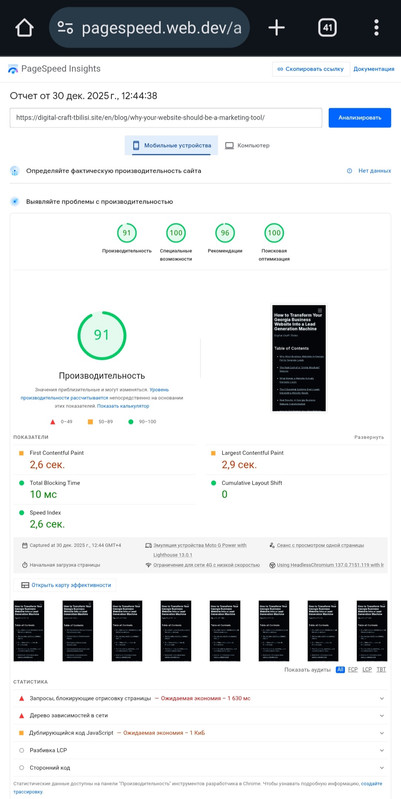
Google PageSpeed Insights (pagespeed.web.dev)
- Tests mobile and desktop performance
- Gives specific recommendations
- Shows Core Web Vitals scores
GTmetrix (gtmetrix.com)
- Detailed performance report
- Waterfall chart shows what's slowing you down
- Historical tracking
WebPageTest (webpagetest.org)
- Test from different locations (choose Eastern Europe)
- Connection speed simulation (test 3G performance)
- Video playback of page loading
Target scores:
- Google PageSpeed: 85+ (mobile), 90+ (desktop)
- Load time: Under 2 seconds on 4G
- Largest Contentful Paint (LCP): Under 2.5 seconds
- First Input Delay (FID): Under 100ms
- Cumulative Layout Shift (CLS): Under 0.1
Costly Oversight #4: Non-Optimized Mobile Experience
Mobile Optimization Gaps in Georgian Web Design
Your website looks great on a desktop monitor but is completely unusable on a smartphone. Buttons are too small to tap, text is microscopic, users have to pinch and zoom constantly, and forms are a nightmare to fill out. This is a critical failure in digital marketing Georgia strategy.
Here's the critical stat for Georgia: Over 72% of web traffic in Georgia comes from mobile devices. If your site doesn't work perfectly on mobile, you're alienating three-quarters of your potential customers in Tbilisi, Kutaisi, and everywhere in between.
Google uses Mobile-First Indexing, meaning they primarily look at your mobile site to determine rankings—even for desktop searches. This makes mobile design a cornerstone of website optimization Georgia.
Real Georgian Business Example:
A Tbilisi-based real estate agency had a beautiful desktop website with stunning property photos. But on mobile:
- Navigation menu didn't work properly
- Property listings were impossible to browse
- Contact forms required 15 fields (nightmare on mobile)
- Images took 20+ seconds to load on 4G
Result? 83% bounce rate from mobile users. After mobile optimization, their mobile conversion rate increased by 294%, significantly improving their online visibility in Tbilisi.
Mobile-First Indexing and Your Search Visibility
- Google penalizes non-mobile-friendly sites in rankings
- Users leave immediately (high bounce rate signals poor quality)
- Lost leads and sales (people can't contact you or complete purchases)
- Damaged brand perception (looks unprofessional)
- Competitors with better mobile sites win your customers
Mobile SEO Best Practices for Georgian Websites
1. Implement Responsive Design
Your site should automatically adapt to any screen size.
Check if your current site is responsive:
- Resize your browser window from wide to narrow
- Use Chrome DevTools (F12 → Toggle Device Toolbar)
- Test on actual devices (iPhone, Android, iPad)
If your site isn't responsive:
- You need a complete redesign (no way around it)
- Use modern frameworks: Bootstrap, Tailwind CSS
- For WordPress: Choose responsive themes (Astra, GeneratePress, Kadence)
2. Optimize Touch Targets
Buttons and links must be large enough for fingers (not mouse cursors) to ensure proper user experience optimization.
Minimum sizes:
- Buttons: 48x48 pixels
- Text links: 44px minimum height
- Spacing between clickable elements: At least 8px
Bad mobile navigation:
[Home] [About] [Services] [Portfolio] [Contact]
← All crammed in one line, impossible to tap accurately
Good mobile navigation:
☰ Hamburger menu that expands to full-screen list3. Simplify Forms for Mobile
Long forms kill conversions on mobile and ruin web presence Georgia efforts.
Mobile-friendly form principles:
- Maximum 5 fields for initial contact
- Use appropriate input types (email, tel, number)
- Auto-fill enabled
- Large input fields (minimum 44px height)
- Clear labels above fields (not inside)
- Single-column layout
Example: Bad vs Good Contact Form
Bad (12 fields):
First Name, Last Name, Email, Phone, Company, Position, Address, City, Postal Code, Country, Message, Newsletter Signup
Good (4 fields):
Name, Phone, Service Interested In (dropdown), Brief Message
You can collect additional information later.
4. Optimize Images for Mobile
Serve different image sizes based on screen size.
Code example:
<picture>
  <source media="(min-width: 1024px)" srcset="large-image.webp">
  <source media="(min-width: 640px)" srcset="medium-image.webp">
  <img src="small-image.webp" alt="Description">
</picture>
5. Test Obsessively
Test on real devices:
- Your own smartphone
- Friend's/family members' phones (different brands/models)
- Test on both iOS and Android
- Test on tablets
Free tools for website optimization Georgia testing:
- Google Mobile-Friendly Test (search.google.com/test/mobile-friendly)
- Chrome DevTools Device Mode (F12 → Toggle device toolbar)
- BrowserStack (paid, tests on 100+ real devices)
6. Mobile-Specific Usability Tips
- Font size: Minimum 16px for body text (prevents zoom on iPhones)
- Avoid pop-ups: Especially on page load (Google penalizes intrusive interstitials)
- Sticky headers: Keep navigation accessible, but don't make it too tall (max 60px)
- Click-to-call: Make phone numbers tappable:
<a href="tel:+995591102653">+995 591 102 653</a> - Fast loading: Even more critical on mobile (see Mistake #3)
Strategic Failure #5: Having No Data-Driven Keyword Strategy
Keyword Research Mistakes in Digital Marketing Georgia
Your website content is based on gut feeling, not actual data about what people search for. You're using technical jargon that nobody searches for, targeting keywords with zero search volume, or competing for impossibly difficult terms. This is a common pitfall in digital marketing Georgia.
Common Georgian business mistake:
A Tbilisi software development company targeting "enterprise-grade scalable cloud solutions" (zero monthly searches) instead of "web development Tbilisi" (1,200+ monthly searches).
Another example: A Batumi tour operator focusing content on "bespoke experiential travel curation" when tourists actually search for "day trips from Batumi" or "things to do in Batumi". Even a small shop in Gori or Rustavi often targets the wrong terms, missing out on valuable organic traffic from Georgia.
Poor Keyword Strategy Impact on Organic Traffic
- You create content nobody searches for (wasted time and money)
- You target keywords you can never rank for (too competitive)
- You miss obvious opportunities (low-competition, high-intent keywords)
- You don't understand your audience's actual language
- Content doesn't align with search intent (informational vs transactional)
Data-Driven Keyword Strategy for Georgian Market
1. Understand Search Intent
Every keyword has intent behind it:
Informational (users want to learn):
- "what is SEO"
- "how to start a business in Georgia"
- "best time to visit Batumi or Kutaisi"
Navigational (users want a specific site):
- "Facebook login"
- "Bank of Georgia online banking"
Commercial (users are researching before buying):
- "best web design companies Tbilisi"
- "WordPress vs custom website"
- "Kutaisi hotels with city view"
Transactional (users ready to buy):
- "hire SEO specialist Tbilisi"
- "book apartment Batumi"
- "order website development"
Match your content to intent. Don't write a 3,000-word guide when someone wants to buy (transactional), and don't pitch services when someone wants to learn (informational). This alignment is key to search performance optimization.
2. Keyword Research Tools
Free tools:
- Google Keyword Planner (ads.google.com) - Search volumes, competition
- Google Search Console - Shows what you already rank for
- Answer the Public - Question-based keywords
- Google Autocomplete - Type your keyword, see suggestions
- "People Also Ask" section in Google results
Paid tools (worth the investment for serious SEO audit Georgia):
- Ahrefs ($99/month) - Best overall, great for competitor analysis
- Semrush ($119/month) - Comprehensive, excellent keyword database
- Ubersuggest ($29/month) - Budget-friendly option
3. Keyword Research Process for Georgian Business
Step 1: Brainstorm seed keywords
List your services/products in plain language:
- Web design
- Digital marketing
- SEO services
- Hotel booking
- Real estate
Step 2: Add location modifiers
- web design Tbilisi
- digital marketing Batumi
- SEO services Georgia
- hotels in Kutaisi
- apartments for sale Rustavi
Step 3: Expand with keyword research tools
Plug your seed keywords into tools and find:
- Related keywords
- Long-tail variations (3-5 words, more specific)
- Question keywords
Step 4: Analyze metrics
For each keyword, check:
- Search Volume (monthly searches) - Aim for 100+
- Keyword Difficulty (competition) - Start with KD 0-30 for new sites
- CPC (cost-per-click in ads) - Higher = more commercial intent
- SERP features - Featured snippets, local pack, etc.
Step 5: Map keywords to pages
Create a spreadsheet:
| Page | Primary Keyword | Secondary Keywords | Search Volume | Difficulty |
|---|---|---|---|---|
| Homepage | web development Tbilisi | website design, web agency | 880 | 25 |
| SEO Services | SEO services Georgia | SEO company, SEO expert | 720 | 32 |
| Blog Post 1 | how to improve website speed | site performance, page speed | 390 | 18 |
4. Georgian Market Keyword Insights
Based on our research:
High-value keywords for Georgian businesses:
Tech/Digital:
- "web development Tbilisi" (880 searches/month, KD: 25)
- "SEO services Georgia" (720 searches/month, KD: 32)
- "mobile app development Georgia" (260 searches/month, KD: 28)
Hospitality:
- "hotels in Batumi" (9,900 searches/month, KD: 45)
- "Tbilisi restaurants" (6,600 searches/month, KD: 38)
- "things to do in Georgia" (22,000 searches/month, KD: 52)
- "guesthouses in Kutaisi" (1,500 searches/month, KD: 22)
Real Estate:
- "apartments for sale Tbilisi" (1,900 searches/month, KD: 34)
- "property investment Georgia" (320 searches/month, KD: 29)
Finance/Business:
- "accounting services Tbilisi" (210 searches/month, KD: 22)
- "business registration Georgia" (480 searches/month, KD: 31)
5. Target Long-Tail Keywords
These are longer, more specific phrases with lower competition, perfect for online marketing in Tbilisi and Kutaisi:
Instead of: "web design" (too competitive)
Target: "affordable web design for small businesses in Tbilisi"
Instead of: "SEO"
Target: "SEO for Georgian e-commerce websites"
Long-tail keywords:
- Easier to rank for (less competition)
- Higher conversion rates (more specific intent)
- Capture voice search queries
6. Optimize Content Around Keywords
Once you've chosen keywords:
- Include primary keyword in: Title tag, H1, first 100 words, URL
- Use secondary keywords naturally throughout content
- Don't keyword stuff (maintain natural language)
- Use variations and synonyms (LSI keywords) like "search visibility" and "digital presence"
Example:
Primary keyword: "SEO services Tbilisi"
Good usage:
"Looking for professional SEO services in Tbilisi? Our Georgian SEO agency helps local businesses improve their search engine rankings and increase organic traffic. With over 5 years experience optimizing websites for Tbilisi-based companies, we understand the unique challenges of the Georgian market..."
Bad usage (keyword stuffing):
"SEO services Tbilisi. We offer SEO services Tbilisi. Our SEO services Tbilisi are the best SEO services Tbilisi..."
Technical Blunder #6: Mishandling Multilingual Websites (GE/EN/RU)
Multilingual SEO Challenges for GE/EN/RU Websites
Your website offers Georgian, English, and Russian versions—which is smart for the Georgian market. But they're not technically implemented correctly. Google gets confused about which language to show which users, leading to poor website optimization Georgia results:
- Russian speakers see the Georgian version
- English speakers see the Russian version
- Google indexes duplicate content (all three versions for same keywords)
- High bounce rate because users can't read the content
Technical issue: Missing or incorrect hreflang attributes that tell search engines "this is the Georgian version, this is the English equivalent, this is the Russian equivalent."
Georgian Market Context:
Georgia's multilingual reality demands proper implementation for effective digital marketing Georgia:
- Georgian (ქართული): Primary language, essential for local audience in Tbilisi, Kutaisi, Gori, etc.
- English: International tourists, expats, foreign investors
- Russian (Русский): Significant portion of tourists and older population
A Batumi hotel we audited was losing 40% of potential Russian-speaking guests because Google was showing them the Georgian version, which they couldn't read.
How Language Implementation Affects Search Rankings
- Wrong language shown to users = immediate bounce
- Google may penalize for duplicate content, lowering your SERP ranking in Georgia
- You can't rank for keywords in multiple languages
- Waste of translation investment
- Lost revenue from international audiences
Proper Multilingual Website Optimization Guide
1. Choose URL Structure
Three options:
Option A: Subdirectories (RECOMMENDED for most Georgian sites)
website.ge/ (Georgian - default)
website.ge/en/ (English)
website.ge/ru/ (Russian)
Pros: All SEO authority stays with main domain, easier to manage
Cons: None significant
Option B: Subdomains
www.website.ge (Georgian)
en.website.ge (English)
ru.website.ge (Russian)
Pros: Languages completely separated
Cons: Divides SEO authority, more complex setup
Option C: Separate domains (NOT recommended)
website.ge (Georgian)
website.com (English)
website.ru (Russian)
Cons: Each domain starts from zero SEO-wise, expensive to maintain
2. Implement Hreflang Tags
This is the technical solution that tells Google which language version to show, vital for any Georgian SEO company.
Code example for a page with all three languages:
<link rel="alternate" hreflang="ka" href="https://website.ge/services/">
<link rel="alternate" hreflang="en" href="https://website.ge/en/services/">
<link rel="alternate" hreflang="ru" href="https://website.ge/ru/services/">
<link rel="alternate" hreflang="x-default" href="https://website.ge/en/services/">
Key points:
ka= Georgian (ISO 639-1 code)en= Englishru= Russianx-default= Fallback version (usually English for international audience)
Add these tags:
- In the
section of every page<head> - Use absolute URLs (full https://website.ge/... not relative /en/)
- Include self-referencing tag (page links to itself)
- Implement on ALL language versions
3. Quality Translation & Localization
Don't just translate—localize:
Machine translation mistakes we see constantly:
English original: "Get a free quote"
Bad Georgian translation (Google Translate): "მიიღეთ უფასო ციტატა"
Good localized Georgian: "მიიღეთ უფასო კონსულტაცია" (Get free consultation - more natural)
Cultural adaptation examples:
For Russian tourists:
- Emphasize visa-free travel
- Highlight safety and hospitality
- Use formal tone (Вы, not ты)
For English-speaking expats/investors:
- Focus on business opportunities
- Highlight English-speaking staff
- Mention international standards
For Georgian locals:
- Use local references and humor
- Mention Georgian payment methods (TBC Pay, BOG)
- Reference local holidays and events in Kutaisi, Tbilisi, etc.
4. Don't Translate Everything
Some content shouldn't be translated:
Blog posts: Write language-specific content
- Georgian blog: Local business tips, Georgian market insights
- English blog: Expat guides, international business
- Russian blog: Tourism content, practical guides for Russian speakers
Keywords: Research keywords separately for each language
- Don't just translate "web design" to "ვებ დიზაინი"
- Research what Georgian speakers actually search for to maximize organic traffic Georgia
5. Language Selector Best Practices
Good practices:
- Clearly visible in header/navigation
- Use language names in their own language: ქართული | English | Русский (NOT "Georgian, English, Russian")
- Remember user's language choice (cookie/session)
- Include flag icons optionally (but don't rely only on flags)
Bad practices:
- Hidden in footer
- Requires multiple clicks
- Doesn't remember choice
- Uses English labels for all languages ("Georgian, Russian")
6. Verify Implementation
Check hreflang in Google Search Console:
- Add all language versions as properties in GSC
- Go to "Settings" → "International Targeting"
- Check for hreflang errors
- Common errors: Missing return tags, incorrect URLs, conflicting signals
Test manually:
- Search Google.ge with Georgian query → Should show Georgian version
- Search Google.com with English query → Should show English version
- Use VPN to test from different countries
Fatal Assumption #7: The "Set It and Forget It" Mentality
Why Georgian Websites Fail Without Ongoing SEO
Your website launched 2-3 years ago and hasn't been meaningfully updated since. No new content, no technical improvements, no adaptation to algorithm changes. It's basically a static digital brochure. This passivity is a death sentence for web presence Georgia.
This is epidemic in the Georgian market. We routinely see businesses spend ₾5,000 on a website, launch it, then do absolutely nothing for years. Meanwhile, search algorithms evolve, competitors publish fresh content, and the site slowly disappears from Google.
Real example:
A Tbilisi-based IT training company was ranking well for "programming courses Tbilisi" in 2022. By 2024, they'd dropped to page 3. Why? Competitors in Tbilisi and Kutaisi published dozens of blog posts about new technologies, updated course information, and actively engaged online. The IT training company's site still referenced "Top Programming Languages 2022" in 2024.
Content Freshness and Search Engine Performance
- Google favors fresh, updated content (recency is a ranking factor)
- You can't build E-E-A-T (Experience, Expertise, Authoritativeness, Trustworthiness) without ongoing demonstration
- Competitors outpace you with new content
- Your content becomes outdated and loses relevance
- Technical SEO issues accumulate, requiring regular SEO audit Georgia checks
- Users perceive your business as inactive or outdated
Sustainable SEO Maintenance Strategy
1. Establish Content Publishing Schedule
Minimum commitment:
- One comprehensive blog post per month (1,500-2,500 words)
- Update one existing page quarterly
- Annual site audit (technical SEO checkup)
Better commitment:
- 2-4 blog posts per month
- Weekly social media posts linking back to site
- Monthly content updates on service pages
- Quarterly SEO audits
2. Content Ideas for Georgian Businesses
For service businesses (agencies, consultants):
- Industry news and trends
- Case studies (anonymized if needed)
- "How to choose a [your service]" guides
- Common mistakes in your industry
- Local market insights
Example blog titles:
- "How to Choose a Web Development Agency in Tbilisi: 10 Questions to Ask"
- "SEO Trends Affecting Georgian Businesses in 2025"
- "Case Study: How We Increased a Batumi Hotel's Bookings by 340%"
For e-commerce:
- Product guides and comparisons
- Industry trends
- Buyer's guides
- Seasonal content
For hospitality/tourism:
- Destination guides for Kutaisi, Gori, Batumi, etc.
- Local tips and hidden gems
- Seasonal travel advice
- Event coverage
Example blog titles:
- "10 Hidden Restaurants in Tbilisi Only Locals Know About"
- "Complete Guide to Georgian Wine Regions: Where to Visit in 2025"
- "Best Time to Visit Batumi: Month-by-Month Weather & Events Guide"
For B2B services:
- Industry analysis
- Regulatory updates
- Best practices guides
- Tool comparisons
Example blog titles:
- "New Tax Regulations for IT Companies in Georgia: What Changed in 2025"
- "Accounting Software Comparison for Georgian Small Businesses"
- "How to Register a Business in Georgia: Complete Step-by-Step Guide"
3. Update Existing Content (Content Refresh Strategy)
Old content can be revitalized to reclaim rankings:
What to update:
- Statistics and data (replace outdated numbers)
- Screenshots and images (refresh visuals)
- Product/service information (current pricing, features)
- Links (fix broken ones, add new resources)
- Examples (replace old case studies)
- Dates in titles ("2023 Guide" → "2025 Guide")
Process:
- Use Google Search Console to find pages that dropped in rankings
- Check competitors who now outrank you
- Identify what they added that you lack
- Expand and improve your content
- Update publish date
- Resubmit to Google via Search Console
Real impact: A Tbilisi legal services firm updated their "Business Registration Guide" from 2021 to 2024, adding new regulations and expanding from 1,200 to 2,800 words. Traffic to that page increased 430% within 6 weeks.
4. Build Topical Authority
Don't write random blog posts. Create content clusters around core topics to enhance online marketing Tbilisi authority.
Example for a digital marketing agency:
Pillar page (main hub):
"Complete Digital Marketing Guide for Georgian Businesses" (5,000+ words, comprehensive)
Cluster content (detailed subtopics, all linking to pillar):
- "SEO for Georgian Websites: Complete 2025 Guide"
- "Facebook Advertising in Georgia: Best Practices & Costs"
- "Email Marketing for Georgian E-commerce: Step-by-Step"
- "Google Ads for Local Businesses in Tbilisi"
- "Content Marketing Strategy for Georgian B2B Companies"
- "Social Media Marketing in Georgia: Platform-by-Platform Guide"
Each cluster article links back to the pillar page, and the pillar page links to all cluster articles. This signals to Google that you're an authority on digital marketing.
5. Technical Maintenance Checklist
Monthly:
- Check Google Search Console for errors
- Monitor site speed (run PageSpeed Insights)
- Check for broken links (use Screaming Frog or Ahrefs)
- Review analytics for traffic drops
Quarterly:
- Full technical SEO audit Georgia
- Update WordPress/CMS and plugins
- Review and improve meta tags
- Analyze competitor changes
- Check backlink profile
Annually:
- Comprehensive site redesign evaluation
- Hosting performance review
- Security audit
- Conversion rate optimization review
6. Monitor Competitors
What to track:
- New content they publish (set up Google Alerts)
- Keywords they rank for (use Ahrefs or Semrush)
- Backlinks they acquire
- Design/UX improvements
- New services or offerings
Tools:
- Ahrefs Site Explorer - See competitor rankings, traffic, backlinks
- Semrush Domain Overview - Competitor traffic analysis
- SimilarWeb - Traffic sources and audience insights
- Google Alerts - Get notified when competitors mentioned online
7. Build E-E-A-T Signals
Google evaluates sites based on Experience, Expertise, Authoritativeness, and Trustworthiness.
How to demonstrate E-E-A-T:
Experience:
- Case studies with real results
- Behind-the-scenes content
- Client testimonials (with photos/names if possible)
- "About Us" page with team photos and backgrounds
Expertise:
- Author bylines with credentials
- Detailed, technically accurate content
- Citations and references to sources
- Original research or data
Authoritativeness:
- Backlinks from reputable sites
- Media mentions and press coverage
- Speaking engagements
- Industry certifications
Trustworthiness:
- Clear contact information (address, phone, email)
- Privacy policy and terms of service
- Secure website (HTTPS)
- No misleading claims
- Transparent pricing
- Client reviews on third-party platforms
8. Track Your Progress
Key metrics to monitor:
In Google Search Console:
- Total clicks (organic traffic from Google)
- Average position for target keywords
- Click-through rate (CTR)
- Impressions (how often you appear in search)
In Google Analytics:
- Organic traffic trend
- Bounce rate (lower is better)
- Average session duration
- Goal completions (contact forms, purchases)
In ranking tools:
- Keyword positions (use Ahrefs Rank Tracker or Semrush Position Tracking)
- Visibility score
- Featured snippets captured
Set realistic expectations:
- Months 1-3: Foundation building, initial improvements
- Months 3-6: Visible ranking improvements for low-competition keywords
- Months 6-12: Significant traffic increases, competitive keyword rankings
- 12+ months: Established authority, consistent lead generation
SEO is a marathon, not a sprint. Consistency beats intensity.
Why Georgian Businesses Need Integrated Digital Marketing (Not Just SEO)
While fixing SEO mistakes is crucial, smart businesses in Tbilisi, Batumi, and Kutaisi understand that SEO is just one piece of the puzzle. An effective integrated SEO strategy works best when combined with a broader digital marketing ecosystem.
In the Georgian market, relying solely on one channel is risky. A comprehensive approach to digital marketing Georgia includes Paid Advertising (Google Ads/Facebook Ads) for immediate traffic, Content Marketing to build authority, Social Media Management for brand engagement, and Email Marketing for customer retention. SEO provides the long-term foundation, but these other channels accelerate your growth.
For example, a new hotel in Kutaisi might use Google Ads to fill rooms immediately while their SEO strategy builds organic rankings over 6 months. A real estate agency in Batumi should use social media to showcase properties visually while optimizing their website for "apartments for sale Batumi". By integrating these efforts, you create a powerful online marketing Tbilisi engine where each channel supports the others—PPC data informs SEO keywords, and high-quality SEO content feeds your social media calendar.
Quick-Reference SEO Checklist for Georgian Businesses
Print this out and work through it systematically to improve your website optimization Georgia:
Local SEO Foundation
- ☐ Google Business Profile claimed and 100% complete
- ☐ Consistent NAP (Name, Address, Phone) across all platforms
- ☐ Location mentioned naturally throughout website (Tbilisi, Kutaisi, etc.)
- ☐ Embedded Google Map on contact page
- ☐ Customer reviews actively collected and responded to
- ☐ Listed in relevant Georgian directories
Technical SEO Essentials
- ☐ Unique title tag on every page (under 60 characters)
- ☐ Compelling meta description on every page (under 160 characters)
- ☐ Proper heading structure (one H1, logical H2/H3 hierarchy)
- ☐ All images have descriptive alt text
- ☐ All images compressed and optimized (under 200KB)
- ☐ Clean, descriptive URLs (no ?id=123)
- ☐ HTTPS enabled (SSL certificate)
- ☐ XML sitemap submitted to Google Search Console
- ☐ Robots.txt file properly configured
- ☐ Schema markup implemented (Organization, LocalBusiness)
Performance & Mobile
- ☐ Page load time under 3 seconds
- ☐ Core Web Vitals in "Good" range (check PageSpeed Insights)
- ☐ Images using WebP format
- ☐ Browser caching enabled
- ☐ CSS and JavaScript minified
- ☐ Fully responsive design (works on all devices)
- ☐ Buttons and links large enough for mobile (48x48px minimum)
- ☐ Mobile-friendly forms (5 fields or fewer)
- ☐ No intrusive pop-ups on mobile
- ☐ Click-to-call phone numbers
Content & Keywords
- ☐ Keyword research completed for your industry
- ☐ Primary keyword identified for each main page
- ☐ Content matches search intent (informational vs transactional)
- ☐ Long-form content on key pages (1,500+ words)
- ☐ Blog with regular publishing schedule
- ☐ Content includes target keywords naturally
- ☐ Internal linking between related pages
- ☐ No duplicate content issues
Multilingual (If Applicable)
- ☐ Proper URL structure for languages (/en/, /ru/)
- ☐ Hreflang tags correctly implemented
- ☐ Professional translation/localization (not machine translation)
- ☐ Clear language selector in navigation
- ☐ Each language version optimized independently
Ongoing Maintenance
- ☐ Monthly content publishing schedule established
- ☐ Google Search Console monitored weekly
- ☐ Quarterly technical audits scheduled
- ☐ Competitor monitoring system in place
- ☐ Analytics reviewed monthly
- ☐ Broken links checked regularly
- ☐ Content updated and refreshed quarterly
Authority & Trust
- ☐ Complete "About Us" page with team photos
- ☐ Contact information prominently displayed
- ☐ Privacy policy and terms of service published
- ☐ Client testimonials and reviews showcased
- ☐ Case studies or portfolio examples
- ☐ Active on relevant social media platforms
- ☐ Backlinks from reputable Georgian websites
FAQ: Common SEO Questions from Georgian Businesses
How long does SEO take to work in Georgia?
Realistic timeline:
- 1-3 months: Technical fixes implemented, foundation established
- 3-6 months: Initial ranking improvements for low-competition keywords
- 6-12 months: Significant traffic increases, competitive rankings
- 12+ months: Established authority, consistent organic lead generation
The Georgian market is less competitive than Western markets, so you may see results faster than average—but only if you're competing against other local businesses. International keywords will take longer.
Factors affecting timeline:
- Website age (new sites take longer)
- Competition level in your niche
- Current site condition (more issues = longer fix time)
- Content publishing frequency
- Budget for SEO efforts
How much should SEO cost for a Georgian business?
Typical pricing in Georgia:
DIY (Self-service):
- Cost: Tools only (~₾200-400/month for Ahrefs or Semrush)
- Time investment: 10-20 hours/week
- Best for: Small businesses with tight budgets and time to learn
Local freelancer:
- ₾500-1,500/month
- Usually one person handling everything
- Best for: Small businesses, basic SEO needs
Georgian SEO agency:
- ₾1,500-5,000/month
- Team of specialists
- Best for: Established businesses, competitive niches
International agency:
- $1,000-5,000+/month
- Advanced strategies, enterprise tools
- Best for: Large companies, international targeting
One-time SEO audit:
- ₾800-2,500
- Identifies all issues, provides action plan
- Best for: Businesses wanting to DIY after getting expert guidance
Red flags (avoid these providers):
- "Guaranteed #1 ranking on Google"
- "Results in 2 weeks"
- "We have secret techniques"
- Won't explain their methods
- Extremely cheap (₾100-200/month for full service)
Can I do SEO myself, or do I need to hire someone?
You CAN do basic SEO yourself if:
- You have 5-10 hours/week to dedicate
- You're willing to learn (plenty of free resources online)
- Your niche isn't extremely competitive
- You're comfortable with basic HTML/website editing
- You can write quality content regularly
You SHOULD hire professional help if:
- Your time is better spent running your business
- You're in a competitive niche (tourism, real estate, finance)
- You need results quickly
- Your website has technical issues you can't fix
- You're investing heavily in digital marketing
Hybrid approach (recommended for most):
- Hire expert for initial audit and setup (one-time)
- Handle ongoing content creation yourself
- Hire for quarterly technical audits
- This balances cost with effectiveness
Do I need SEO if I'm already running Google Ads?
Short answer: YES, absolutely.
Why both are important:
Google Ads (Paid):
- Immediate traffic
- Precise targeting
- Stops when budget runs out
- Cost: ₾0.50-3+ per click (₾1,000-5,000+/month budgets common)
- Good for: New sites, promotions, competitive keywords
SEO (Organic):
- Takes time to build (3-6 months)
- "Free" traffic (after initial investment)
- Builds long-term asset
- Compounds over time
- More trusted by users (70% prefer organic over ads)
Real numbers from Georgian businesses:
Restaurant in Batumi:
- Google Ads: 500 clicks/month at ₾2/click = ₾1,000/month
- SEO: 2,000 organic clicks/month = ₾0 ongoing cost
After 12 months of SEO investment:
- Total ad spend: ₾12,000
- Total SEO investment: ₾8,000 (one-time + ongoing)
- SEO delivering 4x more clicks and still growing
Best strategy: Start with ads for immediate results while building SEO for long-term sustainability.
What's the difference between SEO and Google Business Profile optimization?
Google Business Profile (GBP):
- Your listing in Google Maps and local search results
- Appears in "Local Pack" (map with 3 businesses)
- Shows: Reviews, photos, hours, directions
- Critical for local businesses with physical locations
- Optimization takes 2-4 hours
- Results visible within days
SEO (Organic Search):
- Your website's rankings in main Google results (below ads and local pack)
- Requires website optimization
- Shows: Page titles, meta descriptions, URLs
- Important for all businesses (local and online)
- Optimization ongoing (months of work)
- Results visible in 3-6 months
You need BOTH:
- GBP gets you in map results (highly visible for local searches)
- SEO gets your website ranking for broader keywords
- They work together (GBP links to your website)
Example search "restaurant Tbilisi":
- Top: Google Ads (paid)
- Next: Local Pack (3 GBP listings with map)
- Below: Organic results (SEO-optimized websites)
Optimize both to maximize visibility.
Should my Georgian business website be in Georgian, English, Russian, or all three?
It depends on your target audience:
Georgian only:
- Best for: Local services (plumbers, accountants, lawyers serving only Georgian clients)
- Pros: Simplest, lowest cost, focused
- Cons: Excludes expats, tourists, international clients
Georgian + English:
- Best for: Most businesses in Tbilisi, B2B services, tech companies
- Pros: Serves locals AND expats/international market
- Cons: Translation costs, ongoing maintenance for both versions
Georgian + English + Russian:
- Best for: Tourism, hospitality, retail in tourist areas, real estate
- Pros: Maximum market coverage (tourists, expats, locals)
- Cons: Highest cost, most complex to maintain
Our recommendation for different industries:
- Tourism/Hospitality (hotels, tours, restaurants): All three languages
- Tech/IT services: Georgian + English
- Professional services (legal, accounting): Depends on client base
- E-commerce: Start with main language, expand based on analytics
- Real estate: All three (many Russian-speaking buyers)
Cost consideration:
- Each additional language adds 40-60% to content creation costs
- Translation: ₾20-40 per 1,000 words
- Ongoing maintenance multiplied by number of languages
How do I know if my current SEO provider is doing a good job?
Green flags (good provider):
- Provides monthly reports with clear metrics (traffic, rankings, conversions)
- Explains their strategy in plain language
- Shows you specific improvements made
- Traffic and rankings trending upward over 6+ months
- Responsive to questions and concerns
- Warns you about algorithm updates and adjusts strategy
- Focuses on ROI, not just rankings
Red flags (poor provider or scam):
- No reporting or vague reports ("we're working on it")
- Can't explain what they're actually doing
- Promises specific rankings ("guaranteed #1 position")
- Uses black-hat tactics (buying links, keyword stuffing)
- Traffic isn't increasing after 6-9 months
- Won't give you access to Google Analytics/Search Console
- Charges monthly but does no ongoing work
Questions to ask your provider:
- "What specific work did you do this month?"
- "Can you show me ranking improvements for our target keywords?"
- "What's our plan for next quarter?"
- "Why did traffic drop in [specific month]?"
- "Can I have full access to Analytics and Search Console?"
If they can't answer clearly, consider switching.
How to verify results yourself:
- Check Google Search Console weekly (should see upward trend in clicks)
- Search your target keywords in incognito mode (see your rankings)
- Monitor Google Analytics (organic traffic should grow)
- Track leads/sales from organic search
What's more important: on-page SEO or backlinks?
Both matter, but at different stages:
For NEW websites (0-6 months):
Priority: On-page SEO (80% of effort)
- Get technical foundation perfect
- Create quality content
- Optimize all pages properly
- Build internal link structure
Why: You can't attract quality backlinks until your site deserves them. Fix the foundation first.
For ESTABLISHED websites (6+ months):
Priority: Backlinks (60% of effort) + Fresh content (40%)
- Earn links from reputable Georgian websites
- Guest posting on relevant blogs
- Get featured in local media
- Build relationships with other businesses
Why: Once on-page is solid, backlinks are the biggest ranking differentiator.
Georgian market reality:
- Competition for backlinks is lower than international markets
- Local business directories provide easier link opportunities
- Georgian media outlets often accept guest contributions
- Networking in Tbilisi's business community can lead to natural links
Quick wins for backlinks in Georgia:
- Get listed in Georgian Chamber of Commerce
- Submit to local business directories (BusinessGeo.ge, etc.)
- Partner with complementary businesses (exchange links)
- Get featured in local news (newsgeorgia.ge, civil.ge)
- Sponsor local events (gets you a backlink from event website)
What NOT to do:
- Buy links from Fiverr or cheap link services
- Participate in link farms or PBNs
- Use automated link building tools
- Get hundreds of low-quality links
Quality > quantity. 10 links from reputable Georgian websites > 1,000 links from spam sites.
Will social media posts help my SEO?
Direct SEO impact: NO
Social media posts do not directly improve your Google rankings. Google doesn't use social signals (likes, shares, followers) as ranking factors.
Indirect SEO benefits: YES
How social media indirectly helps SEO:
- Content discovery: Your social posts can attract visitors who then link to your website
- Brand awareness: People search for your brand name (branded searches are valuable)
- Traffic: Social referral traffic signals to Google that your content is valuable
- Amplification: Viral social content can earn backlinks from bloggers/journalists
- Local presence: Active social profiles strengthen local business credibility
Best practices for Georgian businesses:
Facebook:
- Most popular in Georgia (~2.9 million users)
- Post 3-5x per week
- Share blog posts with engaging captions
- Link back to website
- Engage with comments
Instagram:
- Strong for visual businesses (restaurants, hotels, fashion)
- Stories with links (if you have 10k+ followers)
- Use location tags (Tbilisi, Batumi)
- Hashtags: Mix English and Georgian
LinkedIn:
- B2B businesses, professional services
- Share industry insights
- Network with other Georgian businesses
- Post long-form content
Our recommendation:
- Spend 20% of effort on social media
- Spend 80% on SEO (website optimization and content)
- Use social to promote your best website content
- Don't expect social alone to drive significant business growth
My competitor ranks higher but has a worse website. Why?
Frustrating, but common. Here are the likely reasons:
- They have older domain
- Domain age matters (trust factor)
- They've been accumulating SEO equity for years
- Solution: You need patience and consistent effort
- They have more/better backlinks
- Even if their site looks bad, they may have 50-200 quality backlinks
- Check with Ahrefs: Compare your backlink profile to theirs
- Solution: Start earning quality backlinks
- They publish content consistently
- Their blog may have 100+ posts, yours has 5
- Google favors sites that demonstrate expertise through content
- Solution: Ramp up content creation
- They have better local SEO signals
- More Google reviews (quantity and quality)
- More consistent NAP across directories
- Longer Google Business Profile history
- Solution: Focus on local SEO basics
- Their "worse" website isn't actually worse (SEO-wise)
- Design ≠ SEO
- Their ugly site might have perfect technical SEO
- Check their source code, page speed, mobile-friendliness
- Solution: Prioritize SEO over just design
- They're running Google Ads
- Ads don't directly help SEO, but...
- Traffic from ads can indirectly signal quality
- Brand searches increase (ranking factor)
- Solution: Consider paid ads while building organic
How to catch up and surpass them:
- Analyze their backlinks (Ahrefs, Semrush) → Build better ones
- Count their content → Create more and better
- Check their technical SEO → Fix yours first
- Look at their reviews → Get more positive reviews
- Be patient → With consistency, you WILL surpass them
SEO is a long game. A "worse" website that's been optimized for years will beat a beautiful new site. But with proper SEO, you'll eventually win.
What's the difference between SEO and digital marketing in Georgia?
SEO (Search Engine Optimization) is a specialized subset of the broader digital marketing Georgia landscape. While digital marketing encompasses all online efforts—including social media, email marketing, PPC ads, and content strategy—SEO focuses specifically on improving your organic rankings in search engines like Google. For a business in Tbilisi, SEO services build long-term visibility without paying for every click, whereas broader digital marketing might use paid channels for instant results. Think of SEO as the foundation of your house, while other digital marketing tactics are the utilities and decor that make it functional and attractive to visitors.
How does website optimization differ for Georgian vs international markets?
Website optimization for Georgia has unique characteristics compared to US or European markets. First, the competition is generally lower, meaning you can rank faster with proper technique. Second, the multilingual aspect (Georgian/English/Russian) is non-negotiable for many industries, requiring specific technical setups (hreflang tags). Third, the mobile usage rate is higher, making mobile optimization even more critical. Finally, local search habits differ; Georgian users often rely heavily on Facebook and Google Maps, meaning your Georgian SEO market strategy must integrate social signals and local map pack optimization more aggressively than you might in other countries.
Should I hire an SEO agency or digital marketing agency in Tbilisi?
The choice depends on your specific goals. If your primary need is to improve Google rankings and drive organic traffic, a specialized SEO agency Tbilisi is your best bet, as they will have deep technical expertise. However, if you need a full-service approach that includes social media management, paid ad campaigns, and branding along with SEO, a full-service agency offering comprehensive digital marketing services Georgia is preferable. Many agencies offer both, but ensure they have dedicated specialists for SEO rather than generalists trying to do everything, as the technical requirements for modern SEO are significant.
The Bottom Line: Your Website Should Generate Revenue, Not Just Exist
If you've read this far, you're already ahead of 90% of Georgian businesses. Most never take the time to understand why their website fails to deliver results.
Here's the uncomfortable truth: A website without SEO is like a beautiful storefront in an abandoned neighborhood in Rustavi or an unnoticed corner of Kutaisi. Nobody walks by. Nobody comes in. It doesn't matter how good your products or services are.
But here's the opportunity: Because SEO is so neglected in the Georgian market, there's massive potential for businesses that get it right. Your competitors are making these same 7 mistakes. By fixing them systematically, you can dominate your niche.
Start here:
- Audit your current site - Go through the checklist above and honestly assess where you stand
- Prioritize fixes - Start with foundational issues (technical SEO, mobile optimization)
- Create a content plan - Commit to regular publishing to boost digital marketing Georgia efforts
- Track progress - Set up Google Analytics and Search Console if you haven't
- Be consistent - SEO rewards consistent effort over sporadic bursts
Remember: SEO isn't a one-time project. It's an ongoing investment in your business's digital foundation.
Ready to Fix YOUR Website's SEO Issues?
Every website is different. While these 7 mistakes are universal, your site likely has additional specific issues holding it back.
Get a Free, No-Obligation SEO Health Check
We'll provide:
- ✅ Comprehensive technical audit (50+ point checklist)
- ✅ Competitive analysis (how you compare to your top 3 competitors)
- ✅ Keyword opportunity report (low-hanging fruit you can rank for quickly)
- ✅ Prioritized action plan (what to fix first, second, third)
- ✅ Traffic growth projection (realistic expectations for your niche)
No commitment. No sales pressure. Just honest analysis of your website's SEO.
Contact us: